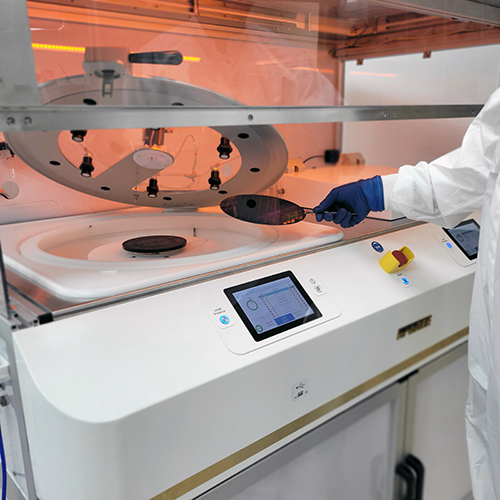
Selecting a spin coater is not about finding the lowest price point that can reach a target RPM. Coating processes demand repeatability, environmental control, traceability, and long-term system stability. Whether evaluating systems for research, university, or production environments, buyers should assess configuration architecture, control depth, automation readiness, and lifecycle durability before making a decision.
This guide breaks down what matters when purchasing a spin coater, what drives real cost differences across the market, and how professional spin coating systems differ from commodity units.
Spin coating systems for research and production workflows are typically purchased direct from the manufacturer and configured to match substrate size, chemistry, process control, and integration requirements.
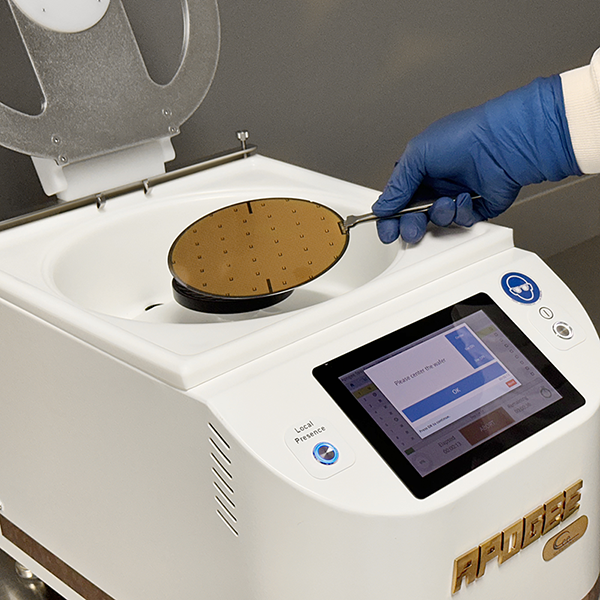
Spin coaters intended for research and production use are not sold as one-size-fits-all instruments. They are typically configured to order based on facility and application requirements such as footprint, installation architecture (benchtop, flange-mount, workstation), substrate size, coating chemistry, film uniformity targets, dispense method, and integration needs.
Professional spin coating systems are commonly purchased directly from the manufacturer or through authorized distributors. The buying process focuses on matching system capabilities to process requirements rather than selecting a fixed retail SKU.
• Substrate size and materials
• Process chemicals and coating materials
• Film thickness uniformity
• Process repeatability
• Dispense method and timing control
• Containment and exhaust requirements
• Safety architecture
• Expected duty cycle and long-term support needs
Uniform films come from controlled acceleration, dwell timing, exhaust management, and dispense coordination, not just top-end speed. Look for:
Multi-step programmable recipes
Closed-loop speed control
Repeatable ramp profiles
Recipe versioning and recall
Why it matters:
Process drift shows up as yield loss, rework, and inconsistent film thickness across lots.
The spin chuck is the mechanical foundation of film uniformity and wafer stability.
Vacuum chuck sealing quality
Substrate size compatibility
Centering and balance
Quick-change chuck options for different substrates
Why it matters:
Poor chuck design causes vibration, runout, and non-uniform coating—issues that can’t be fixed in software.
Spin coating can be messy. Containment, exhaust handling, and electrical isolation protect both results and operators.
Bowl geometry and drainage design
Chemical-resistant materials
Proper exhaust management
Electrical isolation and safety interlocks
Why it matters:
Poor containment and safety design increase contamination risk, maintenance burden, and operational risk in regulated lab environments.
Consistent results depend on where, when, and how material is dispensed.
Programmable dispense timing
Support for multiple dispense methods
Integration with automated dispense systems
Coordination between dispense and spin profile
Why it matters:
Manual dispense introduces operator variability. Integrated control improves repeatability across users and shifts.
When issues occur, being able to trace process deviations is critical for troubleshooting and long-term process stability.
Logging of all recipe parameters
Recipe version tracking and change history
User access controls for editing and executing recipes
Time-stamped records for traceability
Why it matters:
Without process logging and access control, it becomes difficult to identify the root cause of deviations, enforce consistent workflows, or maintain stable processes over time.
Spin coaters aren’t disposable. Look beyond the initial purchase.
Modular component design
Field-serviceable assemblies
Parts availability over long time horizons
Documentation quality
Support model
Why it matters:
A lower purchase price doesn’t help if downtime, obsolescence, or service delays interrupt process development or production schedules.
Designed for direct integration into wet benches, fume hoods, and glove boxes.
Advantages:
Integrates into process enclosures
GUI and controls outside the enclosed process space
Flexible mounting geometry to fit a wide range of bench configuration
Explore Flange-Mount Spin Coaters:
Standalone systems designed for flexible installation in laboratory or R&D environments.
Advantages:
Sits on a table or workspace
Compact footprint
Flexible placement
Easier relocation
Explore Benchtop Spin Coaters:
Provide a unified process environment where spin coating, baking, cooling, and related steps are organized into a cohesive platform.
Advantages:
Multiple process modules contained within a single platform
Delivered pre-configured and ready for installation
Explore Workstation Spin Coaters:
Spin coating is used across a wide range of material systems and process environments. Requirements vary depending on material behavior, environmental sensitivity, and workflow structure. System selection should reflect not just the chemistry being processed, but the control depth, containment needs, and long-term process stability required.
The examples below represent common application categories — not a complete list.
Spin coating is also used for a broad range of advanced materials, including conductive films, nanomaterials, sol-gels, specialty polymers, and other functional coatings.
Selection Considerations:
Fine control of parameters for varied material behavior
Automated and repeatable dispenses
Stable inner spin bowl environment to manage solvent behavior and aerosol containment
Adaptable recipe programming to support evolving or experimental material systems
These applications often require a system capable of evolving alongside the material.
Spin coaters are widely used for applying photoresists and related lithographic materials in semiconductor and microfabrication environments.
Selection Considerations:
Precise acceleration and deceleration profiles
Stable solvent evaporation through controlled airflow
Controlled and repeatable dispense options (manual or automated)
Process logging and traceability for validation
In lithography-driven environments, repeatability and documentation often become primary decision drivers.
Higher-viscosity materials and multi-step dielectric processes require flexible programming and stable environmental control.
Selection Considerations:
Multi-step programmable recipes
Automated dispense integration for repeatable volume control
Stable inner spin bowl environment to manage solvent load during extended spins
Consistent performance across long-duration or high-viscosity processes
For these materials, recipe flexibility and environmental control often outweigh maximum RPM capability.
In research settings, flexibility is often the primary driver.
Typical Priorities:
Unlimited recipe storage
Controlled multi-user access
Rapid process reconfiguration
Compact or modular installation
Systems in these environments must accommodate evolving materials and experimental workflows.
Production and pilot-scale environments prioritize stability and repeatability.
Typical Priorities:
Automation readiness
Integrated workflow modules
Logging and traceability
Long-term serviceability
Here, system reliability and environmental control are often as important as coating performance.
Initial performance is only one part of system evaluation. Long-term reliability, serviceability, and upgrade path often determine the true cost of ownership. Spin coaters are capital equipment, they should remain stable, supportable, and adaptable over decades, not just years.
A spin coater should remain serviceable long after installation. Continued parts availability, accessible system design, and responsive technical support are critical to minimizing downtime. Mature platforms demonstrate their value through sustained field operation and the ability to support legacy systems years, and even decades, after deployment. When evaluating vendors, consider their documented history of long-term tool support and lifecycle availability. (Insert internal link to Product Life / Support Availability page here.)
Control architecture and software stability directly influence how long a system remains viable. A well designed platform should allow expansion, automation integration, and evolving process requirements without requiring full replacement. Systems built with a stable operating environment and forward compatible design can adapt as workflows grow more complex, preserving capital investment over time.
Mechanical integrity under continuous use determines long-term performance consistency. Drive system reliability, solvent compatibility, structural stability, and robust component design all contribute to sustained repeatability. Equipment intended for production or research environments should maintain accuracy and stability through extended operational cycles.
Initial purchase price is only one factor in overall value. Downtime risk, maintenance frequency, integration stability, and long-term replacement cycles all contribute to total cost of ownership. Systems designed for durability, configurability, and sustained support often provide lower lifecycle cost by reducing process interruption and extending operational life.
Spin coaters on the market vary widely in price. That difference usually reflects engineering depth, not just margin.
The reality:
Two systems may reach the same top RPM, but only one may hold process stability across thousands of runs.
| Cost Driver | What It Represents |
|---|---|
| Mechanical precision | Chuck balance, motor control, vibration management |
| Control electronics | Closed-loop speed control, recipe management |
| Containment design | Chemical compatibility, bowl geometry, cleanup efficiency |
| Safety architecture | Electrical isolation, exhaust integration |
| Software | Process repeatability, operator workflow |
| Service model | Long-term parts support and field serviceability |
| Build quality | Systems built for sustained use vs. short duty cycles |
| Category | Commodity Units | Professional Spin Coating Equipment |
|---|---|---|
| Intended use | Light lab tasks, education | R&D, pilot lines, sustained lab use |
| Process control | Basic speed control | Multi-step programmable recipes with closed-loop control |
| Mechanical stability | Limited balancing and vibration control | Engineered chuck centering and vibration management |
| Dispense integration | Manual or loosely controlled dispense | Programmable dispense contorol and integration |
| Logging & traceability | Limited or no process logging | Logging of spin parameters, dispense events, and recipe execution |
| User management & recipe control | Open access with minimal user controls | User access levels, recipe backup, and change tracking |
| Service life | Short duty cycles and limited serviceability | Designed for long-term operation and field serviceability |
| Support model | Vendor-dependent, limited lifecycle support | Manufacturer-supported long-term service and parts availability |
| Integration into workflows | Standalone operation | Designed to integrate into broader process workflows |
This isn’t about brand names—it’s about whether the equipment is designed as a tool or as process equipment.
Spin coating systems span a wide range of use cases, from entry-level benchtop instruments to configurable platforms used in research and pilot production environments.
Cee® designs and manufactures spin coating systems intended for laboratories, process development, and production environments that require repeatability, configurable process control, long-term serviceability, and integration into broader wafer processing workflows. Systems are configured to order and supported as long-term process equipment rather than sold as fixed retail instruments.
This positioning places Cee® in the professional tier of the spin coater market, serving organizations that value stability, supportability, and process control over commodity pricing.
Where can spin coaters be purchased?
Spin coating systems for research, laboratory, and production environments are typically purchased directly from manufacturers or through lab equipment distributors.
Why is pricing not always listed publicly?
Configuration, substrate size, containment options, dispense integration, and automation features significantly affect system cost. Quote-based purchasing reflects real system configuration rather than a one-size-fits-all unit.
How long do professional spin coaters typically last?
Service life is driven by mechanical design, component availability, and support model. Systems designed for long-term serviceability often remain in operation well beyond typical equipment lifecycles. Will it last 2 years or 20 years?
What drives uniformity more: speed or dispense control?
Uniformity is a system-level outcome. Speed control, acceleration profiles, exhaust management, dispense timing, and chuck stability all contribute.
Can a spin coater be integrated into a larger process workflow?
Yes. Professional systems are often designed with communication interfaces, automation options, and exhaust integration to support broader process flows.
Selecting a spin coater is a process decision, not just an equipment purchase. Defining substrate requirements, chemistry, uniformity targets, automation and workflow integration needs provides the most reliable foundation for selecting the appropriate system architecture.
Spin coating systems intended for research and production workflows are available direct from the manufacturer and configured to match specific process requirements.