
Home » Spin Coating: Complete Process Guide for Film Thickness, Materials & Equipment » The Physics of the Process » How Spin Coating Works
Spin coating is often described in a simple sequence: liquid is dispensed, the substrate spins, the film gets thinner, and the coating dries. That description is directionally right, but it hides how the process actually behaves. In real spin coating, those events overlap from the beginning. The final film is not created in one step. It is built continuously as the liquid spreads, redistributes, thins, dries, and gradually loses the ability to keep changing.
The simplified model is useful because it helps readers picture the process. A liquid is placed on the substrate, rotation drives it outward, the film becomes thinner, and solvent leaves until a stable coating remains. But in practice, those stages are not cleanly separated. The liquid begins changing as soon as it is dispensed. Wetting, redistribution, evaporation, and viscosity change all start influencing the result before the coating has had time to stabilize.
That is why spin coating should be understood as a continuous film-formation process rather than a short list of machine actions. What happens at the beginning often shapes what becomes visible much later. A defect noticed near the end may have started during dispense. A thickness problem that looks like a speed issue may really trace back to how the film evolved before it had finished leveling.
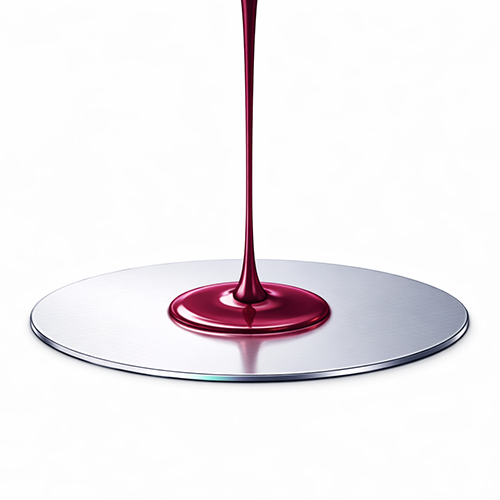
A defined amount of material is applied to the substrate. This can be done as a static dispense (on a stopped wafer) or a dynamic dispense (while the wafer is rotating slowly). The choice affects coverage, air entrapment, puddle behavior, and material waste.
As rotation begins or increases, the liquid moves outward across the substrate. The film is still relatively thick at this stage, and flow behavior is dominated by the liquid’s viscosity, surface tension, and wetting characteristics.
At higher rotational speed, excess liquid is expelled from the edge and the remaining liquid film continues to thin. This is the part most people picture when they think of spin coating, but it is only part of the total process.
As solvent leaves the film, the material becomes more concentrated and more viscous until it no longer levels in the same way. This is when the coating transitions from a liquid film toward its final dry form. For many chemistries, what happens here has as much influence on final thickness and uniformity as the spin speed itself.
A useful way to understand spin coating is to recognize that several things are changing at once. The film is not just getting thinner. The liquid is also redistributing, losing solvent, increasing in viscosity, changing how easily it can level, and moving toward a more stable coated state.
|
Early in the process
|
Later in the process
|
|---|---|
|
Film is thicker and more mobile
|
Film is thinner and less mobile
|
|
Flow can still redistribute the coating
|
Flow correction becomes harder
|
|
Initial asymmetry may still spread out
|
Non-uniformity becomes harder to fix
|
|
Solvent is still relatively abundant
|
Solids concentration is higher
|
|
The film can still level
|
The structure begins to lock in
|
This page gives the full process view: the coating begins changing as soon as it is dispensed, evolves continuously during spin, and reaches its final state only after flow, evaporation, and mobility loss have all played their part. The next pages break that process down further by looking at the stage model, radial flow behavior, the transition from liquid to solid-like film, and the role of solvent evaporation in shaping the result.