
Home » Spin Coating: Complete Process Guide for Film Thickness, Materials & Equipment » The Physics of the Process » The Four Stages of Spin Coating
Spin coating is often described in four stages: dispense, spread, spin-off, and casting. That model is useful because it gives structure to a process that otherwise looks like one continuous motion. It helps explain why some variables matter most at the beginning, why others dominate later, and why a film that looks simple from the outside is actually evolving through several distinct physical regimes.
The key is to use the stage model correctly. These stages are not rigid compartments with sharp boundaries. They are a practical framework for understanding what the liquid is doing and how the process shifts as the coating moves from an initial puddle to a final film.
The four-stage model matters because it helps readers connect process timing to process behavior. A dispense problem does not behave like a drying problem. A spin-up instability does not behave like an evaporation-controlled lock-in problem. When the process is divided into stages, it becomes easier to ask better questions:
That is the real value of the model. It turns spin coating from a vague sequence of settings into a process that can be interpreted in time.
Key idea: The stage model is not there to make spin coating seem simpler. It is there to make the process easier to read.
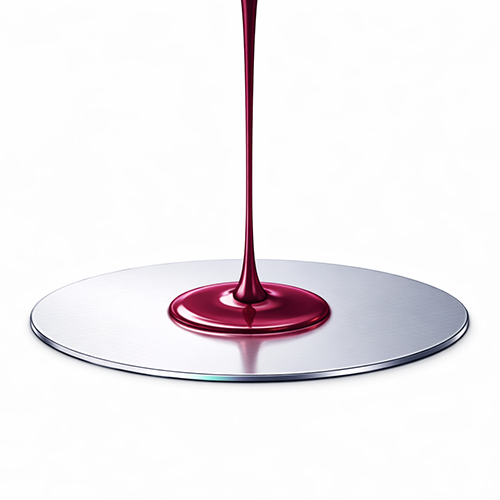
The first stage is dispense. This is the moment when the coating liquid is introduced onto the substrate surface, and it sets the starting condition for everything that follows. The location of the dispense, the amount of liquid, the dispense flow rate, the condition of the material, and the condition of the substrate all begin influencing the coating immediately.
Wetting often begins here. If the liquid does not spread appropriately, later spinning may not fully recover the process. A poorly centered dispense, unstable droplet formation, trapped air, too little or too much material, or a poorly matched dispense rate can all create an initial condition that the rest of the recipe has to fight rather than support.
Dispense flow rate matters because it affects how the liquid arrives at the substrate. The right dispense rate and total amount are not fixed values. They vary with substrate size, substrate shape, coating material, viscosity, and the dispense strategy being used. A setup that works well for one wafer, substrate format, or material may create poor initial coverage or unnecessary instability in another. A controlled, well-matched dispense can help create a centered, predictable starting condition. A poorly matched one can introduce splashing, droplet breakup, air entrainment, or asymmetry before the real spin sequence has even begun.
This stage is also where static and dynamic dispense first matter. In static dispense, the liquid is applied before the substrate reaches meaningful rotational speed, creating a more pooled starting condition. In dynamic dispense, the liquid is introduced while the substrate is already rotating, so radial spreading begins immediately during delivery. Neither approach is universally better. Static dispense often gives a more centralized start and is common in many standard coating processes. Dynamic dispense can be useful when the process benefits from immediate distribution or reduced center puddling, but it usually places greater demands on timing, placement, and dispense consistency.
The larger point is that dispense is not just “put liquid on the substrate.” It is the stage where the film’s starting geometry is created. If that geometry is stable, centered, and well matched to the substrate and material, the rest of the process begins with an advantage. If it is unstable, the film may spend the rest of the recipe trying to recover from a poor start.
What matters most here
For a deeper look at those variables, jump ahead to Dispense Volume and Timing.
The second stage is spread. This is the period when the substrate accelerates and the liquid is redistributed out of its initial dispense condition into a broader, more continuous coating across the surface. The main job of this stage is not to define the final film thickness. Its job is to establish stable coverage and a controlled liquid distribution before later stages take over.
In a static dispense process, this stage is usually very clear. The liquid begins as a more centralized puddle, and the acceleration toward the spin-off speed is what drives that puddle into a wider coating pattern. In a dynamic dispense process, spread is less visually distinct because redistribution is already beginning while the liquid is being delivered. Even so, the spread stage still exists. The liquid still has to transition from its initial delivery condition into a stable, distributed coating as the substrate accelerates toward the next speed regime.
This makes acceleration into the spin-off speed one of the most important variables in the spread stage. If acceleration is too aggressive, the liquid can be driven outward before it has time to spread smoothly, which can create instability, asymmetry, poor coverage, or early flow defects that carry into the rest of the process. But acceleration that is too slow can also be a problem. If the film lingers too long in this early condition, solvent may begin leaving before the liquid has finished spreading properly, which can leave a thicker center or other early distribution problems that become difficult to correct later.
Material behavior matters a great deal here. In general, higher-viscosity materials often need a slower, more controlled acceleration so the liquid has time to spread before it becomes too resistant to move. Lower-viscosity materials can often tolerate, and sometimes benefit from, a faster acceleration because they redistribute more easily. But that behavior is often closely tied to solvent volatility and evaporation rate.
That is why the spread stage should be understood as a balance between distribution and early drying. The liquid needs enough mobility and enough time to spread in a controlled way, but not so much time that solvent loss begins locking in a poor initial distribution. If the spread stage goes well, the process enters the next phase with stable coverage and better symmetry. If it goes poorly, later stages may reveal that weakness as non-uniformity, center-heavy coatings, edge problems, streaks, or poor repeatability.
What matters most here
For the deeper process discussion, see Acceleration and Spread Dynamics.
The third stage is spin-off. This is the phase where the coating is still mobile enough that outward radial flow is doing most of the work. Excess liquid is driven toward the edge and expelled from the substrate, and this is typically where the bulk of the waste is generated.
This is also the stage where exhaust begins to matter much more directly. As liquid is being expelled and solvent is evaporating from the moving film, the bowl and exhaust system begin shaping the solvent environment around the wafer. If vapor removal is stable and well matched to the process, the film can keep thinning under more controlled conditions. If airflow or solvent removal is uneven, drying behavior can shift and edge-related problems often begin to show more clearly.
Spin-off is also where several practical process risks start becoming more important. Because material is leaving the substrate in large amounts, this stage can contribute to splashing, redeposition, backside contamination, and edge-related residue if the bowl environment and process conditions are not well controlled. With more viscous materials, clean separation at the edge can also become more difficult, which may contribute to unwanted stringing or unstable edge loss behavior.
So while spin-off is often described simply as the thinning stage, it is really the point where bulk liquid removal, solvent environment, and edge behavior begin interacting strongly. If this stage is stable, the process moves toward casting under better conditions. If it is unstable, it can seed problems that become more visible later.
What matters most here
For the deeper dives, see Spin Speed vs. Film Thickness and Exhaust and Solvent Removal Control.
The fourth stage is casting. At this point, the film has already gone through dispense, spread, and bulk liquid removal, and the process is shifting toward final film formation. Solvent is still leaving the coating, viscosity is still rising, and the film is losing its ability to continue flowing and correcting itself. This is the stage where the coating moves toward its final thickness profile and its final internal condition as a spun film.
Exhaust still matters strongly here. By this stage, the bowl and exhaust system are shaping how solvent is removed from the film and how stable the local vapor environment remains around the wafer. If solvent removal is well controlled, the film can continue transitioning toward its final state in a more predictable way. If exhaust is too weak, too strong, or uneven, drying behavior can shift, and that can affect thickness, uniformity, and the point at which the film effectively locks in.
This is also the stage where spin speed, spin time, and solvent removal conditions become especially important together. The spin speed still influences how much outward thinning can continue while the film remains mobile. The exhaust and solvent environment influence how quickly the film loses that mobility. Spin time determines how long the coating remains in this evolving condition before the step ends. In other words, the final film is being shaped here by the combination of how fast the wafer is spinning, how quickly solvent is leaving, and how long the process is allowed to continue.
That timing matters. If the step is too short, too much solvent may remain in the film, and the coating may leave the spin stage in a less stable condition than intended. If the step is too long, the process may begin to introduce other problems, including uniformity shifts as the film remains exposed to continued drying and environmental influence longer than necessary. The right endpoint is not simply “longer is better.” It is the point where the film has reached the needed condition without being pushed unnecessarily past it.
This is also a good point to recognize edge bead. By the casting stage, much of the film profile is approaching lock-in, including what is happening near the edge. If excess material has accumulated at the perimeter, or if edge behavior has remained unstable through the earlier stages, that condition can begin to solidify here into a thicker edge region that will carry into the next step. So while edge bead starts with edge flow and liquid loss behavior earlier in the process, casting is often where that edge condition becomes part of the final coated result.
This is why casting should not be thought of as a passive waiting stage. It is still an active part of the process. The film is concentrating, viscosity is rising, solvent gradients may still be developing, and the coating is moving toward the point where its thickness profile and structure are effectively locked in. Once that happens, the film can no longer meaningfully save itself through flow. What remains at that point is what the next process step has to live with.
For the deeper parameter pages, see Exhaust and Solvent Removal Control and Spin Time and Drying Phases.
The real value of this framework is not just that it makes spin coating easier to describe. It makes the process easier to understand and control.
Each stage has a different job:
That structure helps explain why problems often need to be traced backward. A defect seen at the end may have started much earlier. It also helps explain why different process parameters matter at different times. Not every variable affects every stage equally, and not every defect begins where it becomes visible.
For readers building recipes, optimizing coatings, or troubleshooting repeatability, this stage-by-stage view gives the process a much more useful shape.
This is the most important correction to the stage model: the four stages are not perfectly discrete compartments in time. They overlap. A fast-evaporating solvent may begin shifting the process toward evaporation-dominated behavior earlier than expected. A highly viscous material may shorten the period in which flow meaningfully redistributes the film. A dynamic dispense strategy may blur the line between dispense and spread even more.
That is why the stage model should be treated as a physical framework, not a rigid script. It helps readers understand where different mechanisms dominate, but it should not be used to imply that one stage fully ends before the next begins. In real coating work, transitions depend on the material, the substrate, the environment, and the recipe.
One of the most useful ways to apply the stage model is to connect variables to timing. Different parts of the recipe and system matter more at different points in the process. This does not mean they are isolated, but it does help prioritize which knobs are likely to matter most first.
| Stage | Dominant concerns | Common variables |
|---|---|---|
| Dispense | Starting condition, wetting, symmetry | volume, placement, nozzle behavior, substrate condition |
| Spread | Coverage, redistribution, spin-up stability | acceleration, initial speed, wetting, viscosity |
| Spin-off | Flow-driven thinning, edge loss, uniformity | speed, viscosity, radial flow stability, centering |
| Casting | Drying, viscosity rise, lock-in | evaporation, exhaust, ambient conditions, spin time |
Spin coating is one continuous process, but it becomes much easier to understand when broken into four stages: dispense, spread, spin-off, and casting. Each stage contributes something different to the final film, and each stage has its own dominant process variables.
That is why good spin coating is not just about selecting a final rpm. It is about controlling the full sequence.
The next pages in this guide go deeper into the variables that drive film behavior at each stage, starting with the factors that most directly shape thickness, uniformity, and repeatability.