
The core idea
Exhaust settings influence solvent retention and drying during spin coating. A thick-film recipe can use different exhaust settings during prewet, dispense, and drying.
Overview
To achieve ultra-high uniformity on thick films in spin-coating processes, precise control of solvent vapors is crucial. A closed bowl environment and programmable exhaust module enable this control.
One of the most critical results in spin-coating is coating uniformity. In many cases, engineers are challenged to address low uniformity on thick films. To achieve a highly uniform coating, automated control of the solvent vapors is essential. A closed bowl environment combined with a programmable exhaust module allows the solvent vapor concentration to be precisely controlled at various stages in the spin-coating process.
Creating a Solvent-Rich Environment: Prewet Dispense Step
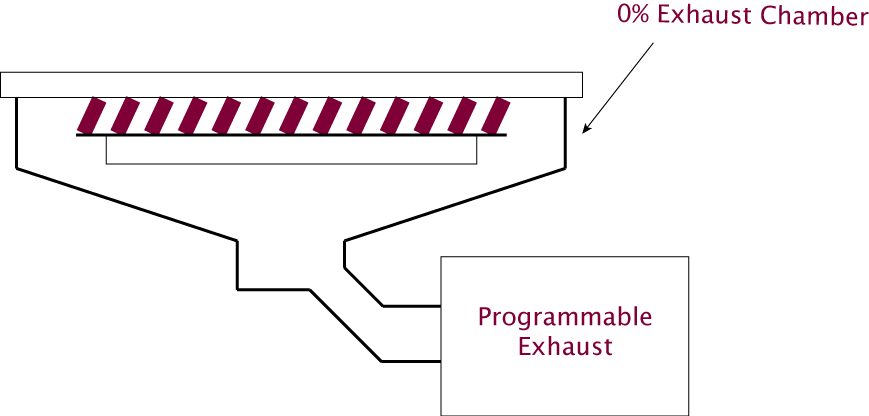
Typically, creating a solvent-rich environment is optimal for the initial dynamic dispense. This step is often accomplished through a prewet dispense step that is performed immediately before thick-film deposition. The step consists of dispensing a small volume of solvent onto the substrate surface, which quickly casts the solvent onto the interior bowl surfaces. This preparation has the dual benefits of increasing vapor enrichment in the spin chamber and prepping the surface of the substrate for optimal spreading characteristics. The spin chamber exhaust is typically programmed to 0% flow during this phase, which mitigates the risk of solvent evaporation prior to the dispense step.
Applying the Material: Dynamic Dispense Step
The dynamic dispense step uniformly spreads the coating material across the wafer surface. The material is applied while the substrate is spinning at relatively low speeds of 200 to 500 rpm. The dynamic method enables optimal coverage of the surface area while minimizing the overall volume of wasted material. Following the deposition step, the spin speed is slowly ramped to establish the final thickness. Depending on the material composition, molecular weight, and viscosity, the exhaust is generally throttled at 0% to 50% closed. The combined effects of spin speed, vapor concentration, and time will determine the final coating thickness.
Stabilizing the Film: Drying Step
Finally, a drying step removes residual solvents and increases the physical stability of the film. Thin-film applications often utilize a higher spin speed for this effect; however, many thick films must remain at a lower speed to prevent additional thinning. We recommend the programmable exhaust be set at 100% during this phase to assist in faster solvent evaporation. This setting provides the additional benefit of removing the residual vapors from the chamber before removal of the substate.
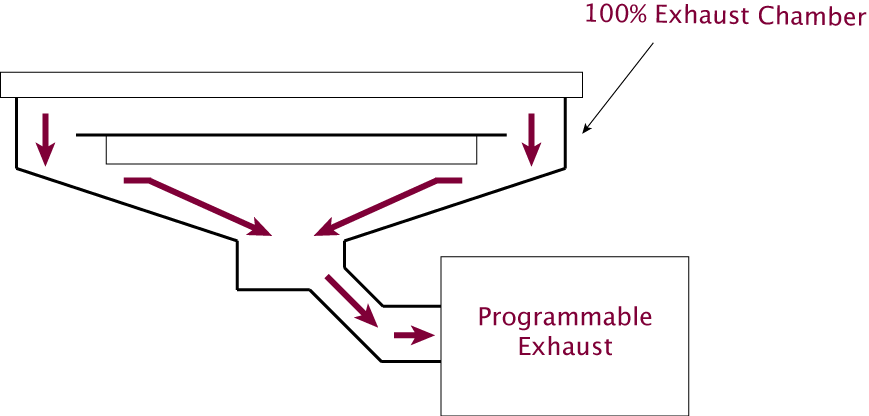
Spin speed, acceleration, and drying rate are the most important variables in determining the final film thickness and uniformity. Cost Effective Equipment products provide these precision controls to enable optimal coating results for lab-scale and pilot-line applications. Contact our sales team for more information today!