
Need a starting recipe for a new material? Browse the Spin Coating Curve Library for grade-specific references. Use this calculator when you have your own coating measurements.
When a coating is close to the thickness you need, a spin speed estimate can help you choose the next trial. Start with a measured film thickness at a known speed, then enter the thickness you want to achieve.
The calculator below provides a quick square-root estimate from one result. If youhave two results from a comparable process, it can also fit a power-law relationship to those measurements. Both options give you a starting point to check with your material and recipe.
The core idea
Use measured coating results from the same material formulation and comparable process conditions. The calculated speed is a starting estimate for a coating trial. Its usefulness depends on how well the model represents your process, particularly near the target thickness.
Calculate spin speed or film thickness
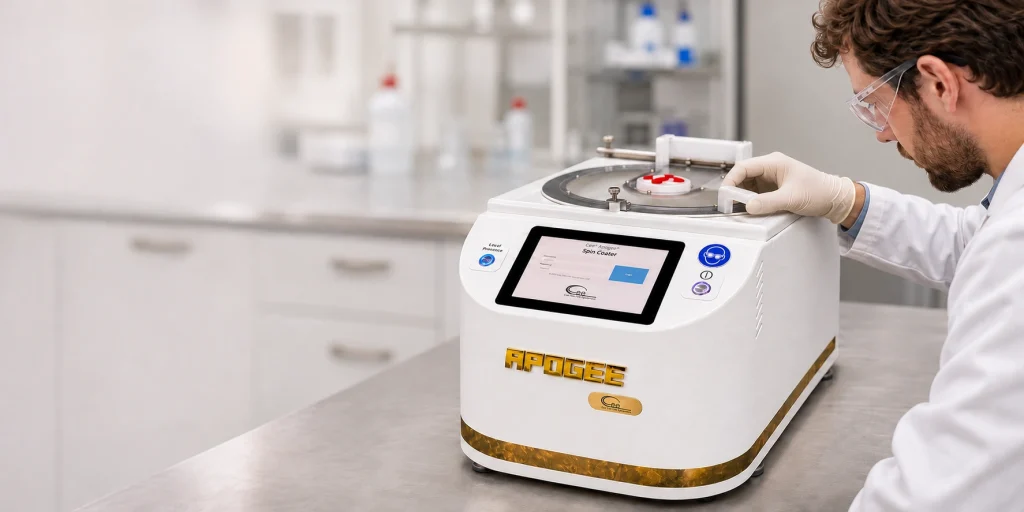
Cee® Apogee® spin coaters provide programmable spin speed, acceleration, and recipe control for your coating process.
How the estimate works
For many photoresist processes, film thickness can be approximated as inversely proportional to the square root of spin speed. The calculator’s one-point method uses that relationship with an assumed exponent of 0.5:
Here, t is film thickness. Reference and target thickness must use the same units. The calculator lets you use micrometers (µm) or nanometers (nm), and converts the entered thicknesses when you change units.
The two-point option uses the more general relationship t = K × RPM−n. It calculates the exponent from your measurements:
The fitted exponent then replaces 0.5 in the speed calculation: RPMtarget = RPMref × (tref / ttarget)1/n. The two measurements need different speeds and a decreasing thickness with increasing speed for this model to apply.
For the broader relationship between spin speed, acceleration, and drying conditions, see Cee® Spin Coating Theory.
A simple worked example
Suppose a trial produces a 2.0 µm film at 2,000 rpm, and your target is 1.6 µm. Using the one-point square-root estimate:
That gives you an estimated speed to evaluate in the next trial, with the other conditions held consistent. The values in this example illustrate the calculation; they are not a recommended recipe for a particular material. Use Try an example above to see the same inputs in the calculator.
Use comparable coating measurements
A useful reference result includes the setup behind the film. Keep the following consistent when generating measurements for the calculator:
- Material formulation, concentration, preparation, and condition.
- Substrate preparation, geometry, and chuck configuration.
- Dispense method and the rest of the spin sequence, including acceleration and duration.
- Exhaust conditions and the coating environment.
- Bake procedure and the stage at which thickness is measured.
For example, compare two thicknesses measured after the same bake procedure. A wet or recently spun film and a baked film can contain different amounts of solvent, which affects the thickness comparison.
The guide to developing a repeatable spin coating process explains how to capture the recipe and setup details together.
Check the estimate with a coating trial
Review the operating limits for your actual substrate, chuck, and equipment before selecting a recipe speed. This calculator estimates a thickness-speed relationship; suitable operating limits come from your equipment and holding configuration. See Selecting Maximum Spin Speed and Acceleration for the factors involved.
Two points establish a curve of this form, while additional measurements help assess how accurately it describes your process. The calculator identifies targets outside the two measured speeds as extrapolations. Check those predictions especially carefully with further trials.
As you collect more measurements, build a spin curve for the material and process conditions you actually use. If the desired thickness calls for unsuitable process conditions, discuss a more appropriate material formulation or coating approach with the material supplier and Cee®.