A coating trial can show that a material and substrate are a promising combination. Once the film meets your needs, the next step is to establish how reliably you can make it again—with another sample, on another day, or with another operator.
That starts with capturing the conditions behind the result. Dispense timing, acceleration, exhaust, sample preparation, and the steps after coating all contribute to the process. Recording them gives you a useful baseline for further development and helps identify which equipment controls will matter as the work grows.
The core idea
A repeatable coating process brings the material, substrate preparation, dispense, spin sequence, exhaust, and any bake steps under consistent control. Save the equipment recipe together with the setup details, then compare repeated runs against a defined result.
Define the result you need to repeat
Begin with the film properties that matter to the application. These might include thickness, uniformity over the usable area, complete coverage, edge condition, or performance in a later process step. Choose acceptance criteria that reflect how the coated sample will be used.
Define how and when you will assess the result. Keep measurement locations and the measurement method consistent, and specify whether the film is evaluated after spinning, after baking, or at another stage. A thickness measurement taken at a different point in the process can be difficult to compare with the original trial.
Record the starting conditions
Record the coating material and its preparation, along with the substrate material, dimensions, cleaning, and any surface treatment. Include the material lot and handling history where those details are relevant. Follow the material supplier’s guidance for storage, conditioning, and preparation.
Identify the chuck and how the substrate is positioned. Changing from a full wafer to a coupon, or using a different chuck, changes the setup being evaluated. Our guide to spin coating small samples covers the holding considerations for pieces and unusual shapes.
For each trial, keep these setup details with the sample identification and recipe revision. This provides the context needed to understand the measurement later.
Capture the complete process sequence
Document the order of operations, including the steps before and after the programmed spin cycle. The following record is a useful starting point; the details you need will depend on the material and application.
| Process stage | Details to record |
|---|---|
| Preparation and loading | Substrate preparation, chuck identification, placement, and relevant handling intervals. |
| Dispense and spread | Static or dynamic dispense, delivery method, amount or delivery settings, position, timing, and spread conditions. |
| Acceleration and coating | Step sequence, acceleration, target speeds, and duration. |
| Exhaust and drying | Exhaust settings and any programmed changes during the cycle. |
| Transfer and bake | Transfer interval, bake temperature, duration, and contact method, where applicable. |
| Evaluation | Measurement stage, method, locations, and acceptance criteria. |
Spin speed, acceleration, and drying conditions work together to influence the film. The Spin Coating Theory article explains those relationships. Select operating limits for the actual substrate and chuck configuration as you develop the sequence.
Make material delivery consistent
Manual dispense is useful during development, especially when changing materials or working with small quantities. Document how the material is applied, including its placement and the interval between dispensing and the next step. For dynamic dispense, record when delivery starts and ends relative to the spin sequence.
Automated dispense can help repeat delivery timing within the recipe. With a pressure-fed system, the delivered amount also depends on source pressure, flow adjustment, material properties, and the fluid path. A repeated valve-open time therefore needs to be supported by a consistent dispense setup.
Choose the delivery arrangement around the material, required amount, and frequency of use. See Automated Dispense Systems for an introduction to the available approaches.
Include exhaust and the steps after coating
Airflow and solvent evaporation affect how a film develops during spinning. Include exhaust conditions in the process record, especially when comparing trials made on different days or transferring a recipe between equipment configurations.
Where fitted, OptiFlow™ programmable exhaust allows exhaust settings to be incorporated into the coating sequence. The settings should be developed for the material and process, with different stages considered together.
If the process includes a bake, document its temperature, duration, contact method, and transfer timing. The Bake Plate Process Theory article explains why the heating arrangement matters. Recording the full sequence helps keep the coating and bake results comparable.
Repeat the baseline, then refine it
Repeat the selected process across enough samples and runs to assess the consistency your application requires. Look at the spread of the measurements as well as the average. Record observations about coverage and edge condition alongside the numerical results.
Give each recipe revision a clear identifier and keep the original baseline available. Make changes with a specific question in mind, such as the effect of acceleration on coverage or dispense timing on spreading. Record what changed and the result.
Some variables interact, particularly dispense, spin, and exhaust conditions. Evaluate the final combination over repeated runs before adopting it as the new baseline.
Use programmable control and logs to support the process
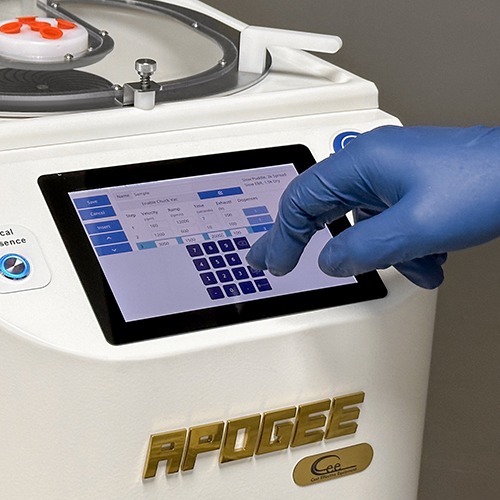
Cee® Apogee® Spin Coaters use DataStream™ OS to create and store recipes with multiple process steps. Saving the sequence gives operators a defined program to run and provides a reference when a process is shared or revised.
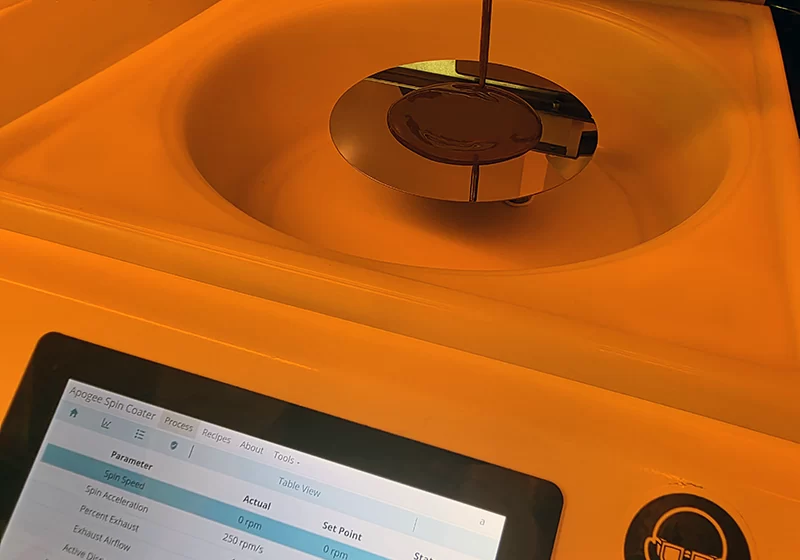
DataStream™ also supports process logging and export for review. Available monitored values depend on the equipment and configuration and can include spin speed, chuck vacuum, exhaust, and ambient conditions. Review the recorded values alongside the recipe and film measurements when assessing consistency.
Add material identification, sample preparation, and measurement results to your process record as needed. A clear procedure, a saved recipe revision, and the associated run records give the next operator a practical basis for repeating the work.