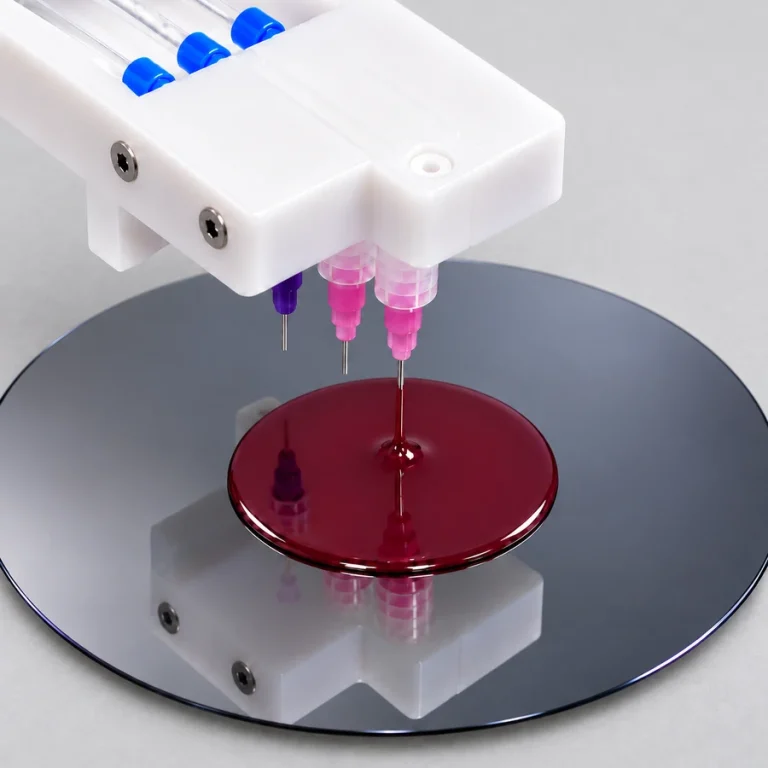
Cartridge dispense uses a pressurized reservoir to deliver coating material through a controlled valve and tip. A range of capacities and reservoir options helps match material consumption and handling needs.
Requires a four-position dispense control box, sold separately. One box supports up to four dispenses. Need more than four dispenses? Add four-position dispense control boxes to expand your system.
Upgraded valve required for this viscosity range.
Cartridge dispense supplies coating material from a pressurized cartridge through a valve to the dispense tip. It provides a practical step up from smaller syringe reservoirs when a process needs more material between refills while retaining a replaceable wetted liner.
Reservoir capacities span 2.5 to 32 oz. Clear cartridges make the material level visible, while opaque options suit photosensitive formulations. A piston barrier can separate the driving gas from the material where gas contact could introduce bubbles.
Flow and suckback adjustments help tune delivery and limit drips between steps. Replaceable polypropylene liners simplify material changes; PFA and PTFE fluid-path components are selected around the chemistry and configuration.
For Cee spin coaters and spin developers configured for pressurized dispensing. Choose a standard Luer outlet or an AccuScan™ Luer connection to match the dispense position. A dispense control box is required and sold separately; the AccuScan™ arm is also a separate product.
Compare the delivery systems by material viscosity, dispense volume, and how you plan to use them. Select a linked system name to view its details.
Swipe or scroll across the table to see every comparison.
| System & typical use | Viscosity (cps) | Dispense volume (mL) | R&D | Production | Material changeover |
|---|---|---|---|---|---|
| Hand dispenseManual R&D dispensingManual reference option | Any | 0.1–30 | Yes | No | Dispose |
| DSD-1 Syringe →Small batches and frequent material changes30 or 55 mL reservoirs | 1–12,000 | 0.1–50 | Yes | No | Dispose |
| Cartridge Dispense →Current pageRoutine coating and production73–940 mL reservoirs | 1–3,000* | 0.1–50 | Yes | Yes | Flush and clean |
| Pressure Can Dispense →Larger supplies and longer runs1–10 gal / 3.7–37 L reservoirs | 1–3,000* | 0.1–100 | Yes | Yes | Flush and clean |
| Dispense Pumps →Precision delivery in productionPump selected for the application | Up to 50,000; pump dependent | Pump dependent | No | Yes | Flush and clean |
* Cartridge and standard pressure-can systems support up to 5,000 cps with an upgraded valve. Pump capability depends on the selected model. Reservoir capacity and dispense volume are different values; dispense volume is the amount delivered in a dispense.
Use the selector to choose 2.5, 6, 12, 20, or 32 oz around material consumption and refill frequency. Specify light sensitivity and whether a piston barrier is needed when matching the cartridge and liner to the formulation.
Choose the ⅛″ line and valve for 1–100 cps, the ¼″ arrangement for 100–3,000 cps, or the upgraded ¼″ valve for 3,000–5,000 cps. Select standard Luer or AccuScan™ Luer delivery; these choices determine the displayed SKU. Confirm wetted-material compatibility and the available control-box position before ordering.
The tip kit provides several nozzle diameters to fine-tune delivery for your material viscosity and suckback needs.
Optional: Additional disposable liners and pistons.
Purchased separately: The dispense control box and, for AccuScan™ delivery, the AccuScan™ arm.
2.5–32 oz / 73–940 mL
1–3,000 cps standard; up to 5,000 cps with upgraded valve
PFA, PTFE, chemically resistant polypropylene copolymer
The cartridge assembly and stand have the same dimensions for the 2.5, 6, 12, 20, and 32 oz cartridge sizes.
6″ (15.3 cm)
10″ (25.4 cm)
18″ (45.7 cm)
Allow at least 12″ (30.5 cm) above the reservoir for access to the lid and top components.
Nitrogen or clean dry air
70 psi to the dispense control box
Need heated dispensing, a special delivery method, or a configuration you don’t see here? Cee® offers custom solutions built around your material, equipment, and process.
See examples of our custom equipment, then contact Cee® to discuss your dispense requirements.